I hope you will find things among my random thoughts that resonate with you and yours. I'd love to read your reactions in the Comments, and I'll be sure to visit you in return. Best regards, Mary

Showing posts with label history. Show all posts

Wednesday, April 30, 2014

Zeppelin: Graf, Aircraft Carrier, Dirigible and Led

What a strange foursome!  How did they get together?

First came Ferdinand Adolf Heinrich August Graf von Zeppelin, 1838 - 1917. 

Often known simply as Graf Zeppelin, the count (Graf) was a German general who later founded the Zeppelin Airship Company. He served in the Prussian engineering corps, then as a general staff officer in the Austro-Prussian War of 1866. He did reconnaissance in the Franco-Prussian War of 1870/1871 and had various other assignments until retiring from the military in 1890.

He was also involved in our Civil War as an "observer" for the northern troops in 1863, and he participated with Russians and Indians in an expedition to the source of the Mississippi. But perhaps his most important activities in this country were his visits to our balloon camps. He made his first ascent at St Paul, Minnesota, and a life-long interest in aeronautics was born.

The Rise and Fall of Rigid Airships


The count first mentioned an idea for large dirigibles in his diary on March 25, 1874, and in 1891 when he retired he began testing materials and engineering concepts. Despite engineering and test issues, logistics, and political hurdles, work continued. Finally, on July 2, 1900, the first successful flight of LZ1 took place in southern Germany. Several more models were built and progress was relatively steady, but Zeppelin's relationship with the military was poor, so he turned to commercial airships in order to capitalize on the growing public enthusiasm. By 1914,  37,250 people had flown safely with his German Aviation Association. 

Due to the commercial success of airships, "zeppelin" entered vernacular speech as the name for rigid airships. Both the LZ 127 (the Graf Zeppelin) which eventually circled the world,  and the LZ 130 Graf Zeppelin II were named for him.

The LZ 130 was the twin to the LZ 129 Hindenburg which in 1937 met a fate so terrible that it put an end to the "zeppelin era".


World War II: the German Aircraft Carrier Graf Zeppelin 


The only carrier launched by Germany in World War II was named for the count. It was launched December 8, 1938, but it was never completed or operational.

Led Zeppelin, The Band


There are several stories about how the band got its name, but one thing is certain: the count's granddaughter, Countess Eva von Zeppelin, once threatened to sue the band for using it. One story seems plausible: the band originally was known as The New Yardbirds. But when a newspaper article proclaimed that it would "go down like a lead zeppelin" the name stuck except for the spelling. 


Tuesday, April 29, 2014

Yerkes Observatory


Operated by the University of Chicago at Williams Bay, Wisconsin

One of many astronomical observatories throughout the world, it claims to be "the birthplace of modern astrophysics". Completed in 1895 with a lens diameter of 40 inches, the Yerkes remains to this day the largest achromatic refracting telescope used for scientific purposes.

The 40-inch Diameter Refracting Telescope

                                         1897 Photo                                              2006 Photo


In addition to its distinction as the largest it may also be the one with the most colorful history. It was financed by a known criminal, Charles Tyson Yerkes. Astronomer George Ellery Hale convinced the convicted but wealthy embezzler to finance the telescope, regardless of cost, providing that it be the world's largest. Which, indeed, it was. And so it bears his name. 

Monday, April 28, 2014

Xanadu

Just for fun, here is some of what I found when I googled Xanadu:

It's a Place,  a Fine Art Gallery, a Movie, a Song . . . all inspired by an ancient ruin, details on the ...

UNESCO World Heritage list at Xanadu Site Ruins

Located in what is now Inner Mongolia, Xanadu was the cool summer home of the khan of that era. It included both a beautiful marble palace and one made of strong cane, along with a vast and beautiful park where the khan enjoyed riding. In 1872 a Britain with the Legation in Beijing visited the site and found blocks of marble, tiles and other artifacts. But by 1990 everything was gone, probably used by locals in building their town. Only some art now remains in the walls of that town, Dolon Nor.

The name became famous in our times with the revival of the poem Kubla Khan by the English romantic poet Samuel Taylor Coleridge. Written it in 1797 while he was apparently under the influence of opium, it praises the city built during the period 1252-1256. It was visited in 1275 by Marco Polo who later (1298-99) dictated a description of it in glowing detail. In 1369 it was occupied and burned by an enemy, and then abandoned for several hundred years.

Picture Gallery:  UNESCO's details and pictures of remains at the site.


"Resource for collectors, designers, builders, and corporations for procuring the highest quality art ..."


Xanadu:  1980 Romantic Musical Fantasy Film. 
A musical based on the film also opened on Broadway in 2007. 
I don't recall either of these. If any readers do their comments will be welcomed. 


AND FINALLY . . . 

Oilvia Newton John sings "Xanadu".  I wonder how the khan would have liked this!


Saturday, April 26, 2014

Wild West


Beloved mythology of the US, the Wild West period is more fiction than truth. It's a story of conquest and survival, promise and disappointment, creation and destruction, and always clashes between differing cultures and species. As David Murdoch said, "No other nation has taken a time and place from its past and produced a construct of the imagination equal to America’s creation of the West."1

All of that is controversial and complex, continually researched, updated and disputed. But there is one perspective that all agree on: the west in its pristine and wild state was bountiful and beautiful. And happily there are parts of it that remain unchanged to this day.

As AtoZ Challenge draws to a close I'd like to share with you some pictures of that still "wild west". I have visited these sites but without a camera, so I rely on Getty Images and the professionals to capture them for you. They bring wonderful memories to life for me and probably for some of you. If you have not stood in these places perhaps you will be inspired to take "the trip of a lifetime".

Bryce Canyon


Monument Valley


Colorado in Spring Bloom


Great Sand Dunes of Colorado


Rocky Mountains and River in Montana


1 From Wikipedia:  Murdoch, David (2001). The American West: The Invention of a MythUniversity of Nevada Press. p. vii.ISBN 978-0874173697

Friday, April 25, 2014

Victoria, Queen of England

When I moved into my 1893 Victorian house I began to feel a kinship with Queen Victoria.
(For more about that house and living in it visit Mary in Michigan.)

Engraving From 1873


The Queen in her Robes of State


Queen Victoria Lived From 1819 Until 1901, ruling  as Queen Of England From 1837 Until 1901. That means she ruled the country for 63 years, beginning when she was 18 years old and continuing until she died in 1901 at the age of 82. Amazing!

What sort of person was she? How did she manage to remain in that position for so long, surviving wars, assasination attempts, and domestic intrigue at a time when women generally had no standing as citizens or even as people in their own right? And from 1876 she also served as Empress of India. 

The answers could lead to many hours of research, so here are a few facts just for fun: 
  • She was an only child, reared by a single mother. And she herself became a single mother. 
  • She stood barely 5 feet tall, but developed a girth of perhaps 50 inches over the years.  
  • Her tutor and mentor was Lord Melbourne, who also was her first prime minister. 
  • In 1840 she married Albert, Prince of Saxe-Coburg and Gotha, to whom she proposed.
  • She and Albert had 9 children, 4 boys and 5 girls. 
  • She was a hemophilia carrier and passed the condition to her son Leopold who died at 31. 
  • Two of her daughters were hemophilia carriers. They passed it to Spanish, German and Russian royal families. 
  • When Albert died in 1861 she went into seclusion for many years, neglecting royal duties. 
  • By the mid 1870's she began to participate more actively again.
  • By her Golden Jubilee in 1887 she had fully returned to her earlier popularity. 

Thursday, April 24, 2014

Utopia

An imaginary place where life is perfect. Each person's would be unique. What would yours look like?

Here's what the site of mine might look like:


More important, how would it feel? What would I do each day? Who would share my utopia with me? Each person would answer those questions differently.

Look the word up and you'll find descriptions of peaceful societies or communities governed by rules that treat all members fairly, often with communal living arrangements. This wistful notion has roots in the lost Garden of Eden and the Golden Age of Greek mythology, and is reinvented in every period when men dream of a different and better life. Sometimes in various countries they even try to create it.

Keep reading and learn of American "utopian communities" that failed. I have visited the remnants of several: a Shaker village in Massachusetts, the Amana colonies in Iowa, and New Harmony, Indiana. Most are now gone or museum sites, some on the National Historic Register.

But a new effort is under way. In August, 2013, the Huffington Post published an artricle describing nine "alternative modes of living" which are open to new members:  9 Utopias That Really Exist

They are located in several countries with six in continental US, one in Hawaii, a group of 25 "elevated structures" in Costa Rica, and the incredible modernistic city New Songdon in South Korea on Incheon Bay. It is built from scratch, like Dubai, and scheduled for completion in 2015! It's a "far cry" from any in the past, but Who Knows? Maybe this one will succeed:

Flickr: Nicolette_Mastangelo                  


Tuesday, April 22, 2014

Sierra Nevada (aka What's in a Name?)


In Spanish the word sierra can refer either to "mountain range" or to "saw". That double meaning is known as "disambiguation" (a new word for me), but let's not go there! We are interested in a mountain range, and translate Sierra Nevada in the western US as the "Nevada Mountain Range".

But wait - we're not done. Nevada in Spanish means "snowfall" or "snow clad" in English. So the full meaning of Sierra Nevada is roughly "Snow-Covered Mountain Range". I think that is beautiful. (If Spanish-speaking readers are cringing I hope they will put a correction in the comments.)

That's the end of the cultural vocabulary lesson. I set out to write a little something about what I call the Sierra Nevadas but immediately ran into all that information. I share it with you because I feel that knowing the "back story" of anything adds a dimension.

So "without further ado" I introduce the Kiersarge Pinnacles of the Sierra Nevada, named for the 1861 Civil War vessel USS Kearsarge, which was named for Mt Kearsarge in New Hampshire. 


There are dozens of pictures showing the beauty of the range, but I was drawn to the one above for its eerie "other-worldly" feel. For geographical interest as well as beauty some examples are . . .

         Mt Whitney, highest peak in the range            and                    Yosemite Valley  


The mountain range encompasses a vast area of land, much of it owned by the Federal government. It includes 3 national parks and 2 national monuments, plus many towns and communities such as Carson City, South Lake Tahoe, Truckee, Grass Valley, Mammoth Lakes, Sonora, Nevada City, and Portola.

* * * * * * * * * *

Finally, a bit of geologic history:  20 million years ago there was major volcanic activity in this area. (Granite from that period is visible in places.) After millions of years, a crust began to form which tilted slowly westward. Rivers cut deep canyons on both sides, some of which filled with lava, and over time eroded to "table mountains".

Then the earth began cooling. Glaciers carved out U-shaped canyons, while the tilting or "uplift" never ceased. The result is two opposing forces of nature, invisible to us but forever reshaping the landscape. This uptilt makes an especially dramatic view on the eastern side as seen in the "Sierra Escarpment" below.  Measurable only with scientific instruments, the relentless movement is often responsible for today's earthquakes.


Saturday, April 19, 2014

Quetzalcoatl


The feathered serpent of ancient Mexico was a main god in Mesoamerica for most of the 15th century. But when the first Spaniards arrived in 1519 their leader Hernan Cortes, in his shining armor and plumed helmet, looked like the Mexicans had imagined their god. So they revered him and welcomed his army, thus sealing the fate of their civilization. 


Here is how the ancient Aztecs carved Quetzalcoatl in stone.


This is how we imagine him today from descriptions the ancients left us.


Knowing the story of the god and the sad mistake by the ancient Mexicans I was eager to visit Chichen Itza when in Mexico to see the famous Mayan pyramid and surroundings. Despite a miserable ride in a bouncing bus and the relentless heat I was not disappointed: 


The history and myths are too long and complicated for this post. So if you are not familiar with them I suggest a little internet research. I guarantee you will enjoy the journey to ancient times and culture.

Wikipedia has a very nice summary to get you started:  Wikipedia on Quetzalcoatl  I recommend this because so many sites about this myth are meager or have copyright requirements. This one has lots of good information and splendid pictures.

Enjoy! 

Wednesday, April 16, 2014

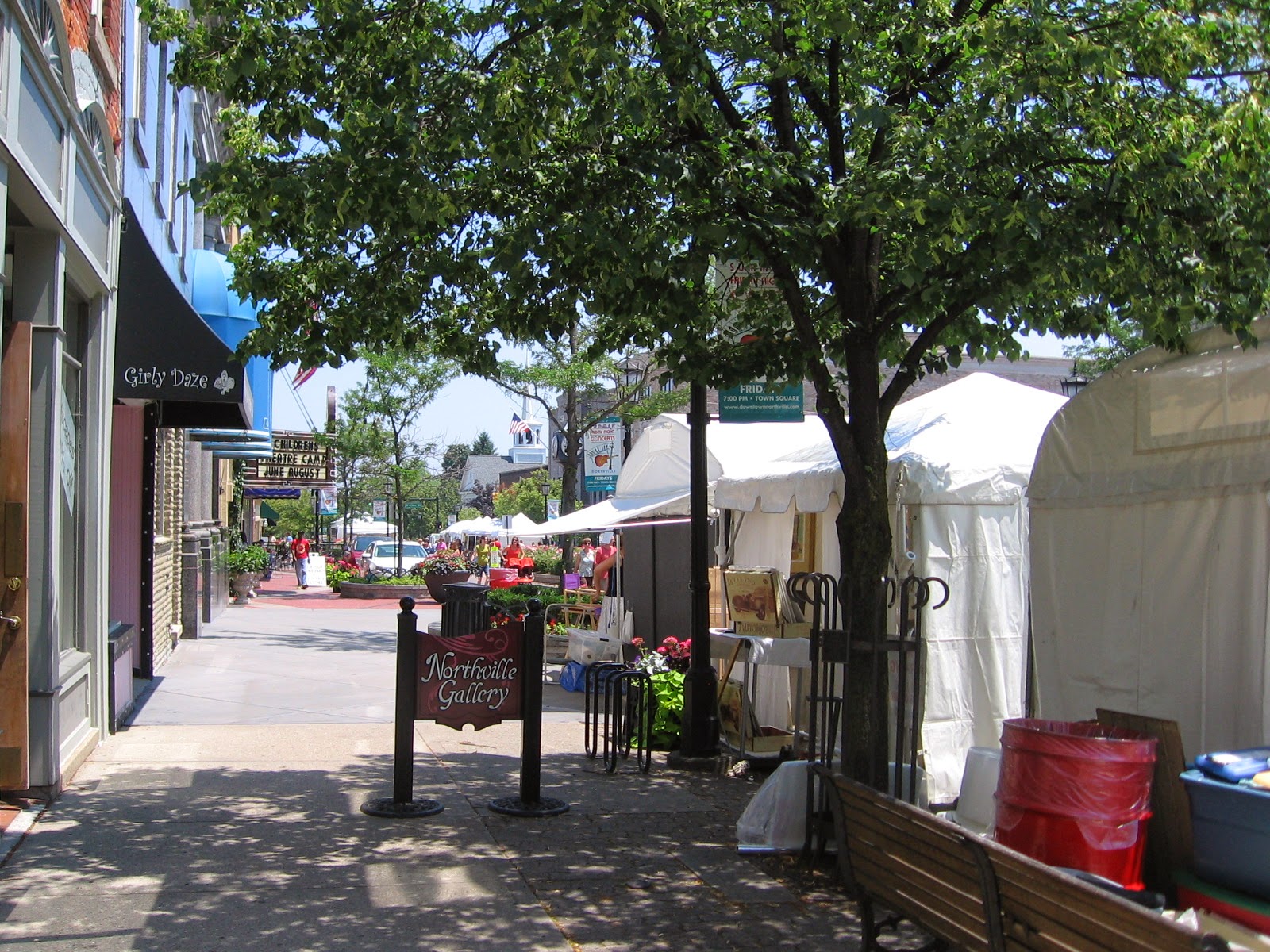
Northville, My Home Town

This village of 2,500 people in sourthwest Michigan is located in huge Wayne County which also contains Detroit. Northville's first "land patent" is dated in 1823, placing it 30 miles from Detroit - a journey of three days. Now it takes a half hour for my son to drive from his Northville bakery to suppliers in Detroit.


Great Harvest Bakery Northville, my son's busines.


I moved here 3 years ago after 10 years of visiting from my home in Ohio. I could not resist the double lure of the town's old-fashioned charm and my growing family, so I found an 1893 house just ten minutes' walk from my son's bakery in the tiny "down-town".


Northville is in the northwest corner of Wayne County, the largest in Michigan. It covers 614 square miles, 2/3 the size of Luxembourg at 998 square miles. (It is larger than six other European countries including Vatican City.) It holds several townships, each containing other suburbs, as well as Detroit Metro Airport which covers 11 square miles according to the 2010 census - likely more today. 

For some wonderful tours of Detroit and the area click here: Video Tours  And for more personal views of Wayne County and some current issues you can visit another of my blogs: Mary in Michigan

To whet your appetite, here are some great stills:        


                      Part of Detroit's Reality Today: Ambassador Bridge to Canada       


International Freedom Festival, June 2008


I did not realize when I came to live here that my two feet would would be firmly planted in different eras, with 200 years between! Our news contains a jumble of information about Detroit's looming bankruptcy and related lack of public services, the auto industry's resurgence, third-world conditions in the "inner city", and exciting programs of the arts and culture. Not to mention weekly community events from concerts to marches to races, all usually with fireworks over the river.

It's a fascinating place to live, in the middle of "the action" yet as far from it as one can get. For details and pictures of some of it I invite you to visit my personal journal at MARY in Michigan


Saturday, April 12, 2014

The Kremlin

My tour of Moscow's Kremlin was the highlight of my visit to Russia. That might not have been the case had it received broader publicity in the US media, but with only dark and dreary images in my mind I was unprepared for its brilliant beauty. The month was May and we were the first tourists of the season, so flowers were freshly in bloom and everything sparkled with sunshine and color. It was glorious!

The Kremlin is a heavily walled fortress whose origins date to 1147. Construction and expansion continued until the end of the fifteenth century when today's complex was completed.  

Because of its situation walled in on the hill it is hard get a picture of the Kremlin except from the air, but this one is pretty good. Look hard and you will see a section of wall running behind a small gold "onion dome" about 2/3 of the way down in the center. 

The picture below it is taken from outside that part of the wall looking up at it. A tall green steeple with a red star on top is in both pictures and will help you orient orient yourself. 


The view bellow is from outside the wall as we approached it in line, awaiting our tour. (Notice again the green steeple with the red star atop.) Of course we were there during the day, but it's a better angle to get a feeling for the wall.


From the Moskova River one gets a sense of the size of the complex, and again how colorful it is. And all around it is that wall. On the other side, out of sight, is Red Square. Also very colorful, and much smaller than it seems in pictures. I thought of those black and white news films years ago of apparently endless rows of Russian soldiers marching with row upon row of tanks. Surely there was not enough space for all that!


"The Moscow Kremlin, sometimes referred to as simply the Kremlin, is a historic fortified complex at the heart of Moscow, overlooking the Moskva River (to the South), Saint Basil's Cathedral and Red Square (to the East) and the Alexander Garden (to the West). It is the best known of kremlins (Russian citadels) and includes five palaces, four cathedrals and the enclosing Kremlin Wall with Kremlin towers. The complex serves as the official residence of the President of the Russian Federation."
 Getty Images. 


And finally, a look inside: "Standing in the center of the Kremlin in Moscow viewing the Cathedral of the Assumption and The Ivan the Great Bell Tower on a beautiful afternoon." Getty Images

Putin's flag was flying on the official residence as we strolled among the buildings and into these cool dim cathedrals. I fantasized him looking out the window at us, perhaps wondering what these Americans thought of his beautiful Kremlin.


Friday, April 11, 2014

J is for Jade, not Just for Jewelry

Most Beautiful and Perhaps most Versatile of All Minerals.


I love jade. I have just three pieces, a bangle (bracelet carved entirely from one piece of jade), an intricately carved pendant (very special gift) and one earring. They are my treasures and I hope to add to them one day. 

This plentiful, carvable substance is simply a rock, not just one ornamental rock but two silicate minerals: nephrite and jadeite. From there it gets complicated, but it's enough to know that jade in one form or another has been treasured and carved since prehistoric times. Its uses vary from ornaments to knives, bowls to animal figures, and there are even a few complete buildings made of jade. 

Although ancient jade relics are found on virtually every continent much of what we know about its early use comes from China. And despite this widespread appearance in earliest times Wikipedia has only sparse information about it. Other sources tell us that the history of jade in China goes back to the Neolithic period, about 5000 BC, where it became an integral part of the culture itself. It was valued not only for its beautiy but was likened to every possible virtue. That was detailed explicitly in teachings of Confcius and thus became a permanent part of the culture.

* * * * * * * * * * * * * * *

Yes, all those stones are jade. It's not just green. It is found in virtually every color possible.

                              
Jade can be carved into the most intricate and delicate designs and figures imaginable.
Those below are from China.


* * * * * * * * * * * * * * * 


Now that I understand the legality of using pictures from the internet I was disappointed to find that I could not share the best with you. 

So I recommend an internet tour of sites about jade in different countries. In addtion to fascinating information, I think you will enjoy seeing such finds as the primitive Pre-Columbian carvings from South America, delightfully sophisticated ones by Maoris in New Zealand, and surprisingly beautiful creations from Russia - including lots of skulls from Siberia. 

Tuesday, April 8, 2014

Gardening

There are flower gardens, vegetable gardens, kitchen gardens, and truck gardens. We all know about flower, vegetable and kitchen gardens even if we aren't gardeners. But what grows in a "truck garden"? Surely not trucks.

Truck garden is just another name for a "market garden" where vegetables are grown to be sold locally, often in local "farmers' markets". Because freshness is a requirement and the produce is often perishable it is "trucked" to market as soon as possible after picking. Hence the nineteenth century name which is seldom heard these days. But the practice is alive and well, even growing in some places. Many of us still scurry down as early as possible on market days to get the best berries or veggies, knowing they'll be picked over if not completely gone by 9 or 10 a.m.

* * * * * * * * * 

I know very little about gardening of any kind, but that's my current project, which is why I included it in the challenge. It gives me a chance to articulate my ideas and research as I develop my hopes for this summer.

I call these "hopes, not "plans" because I called them plans last year and never got beyond the hoping stage. There are two areas behind my house where I want to plant something attractive that requires little care. Choosing the right plants was the purpose of yesterday's post on Flowers.

Behind my garage there is a 20 x 20 foot area that is lumpy, with buried concrete chunks and a lot of clay and weeds. It needs to be evened out and a layer of good dirt laid down. Farther back is another plot the same size on which stood a cottage until recently.


It was charming but unstable, and the cost to repair it was too high. Some buried trash remains to be removed and the whole area smoothed out. There's black dirt which will be fine for planting. 

Here's the back yard layout, not to scale but it gives a good sense of proportion. One plot for attention is between the Garage and "Ret wall" (retaining wall with a white picket fence on it). The other is below the label Retaining Wall on the layout where the cottage was.


Here is how the yard looked last summer with the cottage intact. The garage is on the left, white picket fence behind it on the retaining wall, labeled "Ret wall" in the layout above. The lower left area below the label "Retaining Wall" is where the cottage stood. (See it way in the back.) 


It's clear from the picture above that there is lots traditional gardening area which I do easily, but I can't add to it the preparation, planting and maintenance of the two new areas. They need to be "plowed" with something motorized, and the one between the garage and picket fence also needs a load of dirt laid. It's time to have that done and I think I have the man for the job. I hope to schedule him in the next few days and I'll report on that as a PS on this post.


Thursday, April 3, 2014

Culinary Historians

By now everyone has heard of Julia Child, that tall lady with a passion for food who brought French cuisine to American kitchens. I think she would have great fun with today's foodies. And she surely would have loved her 100th birthday party despite the Michigan heat of an August day in 2012. That was just one of many events regularly hosted by the Culinary Historians of Ann Arbor (CHAA).


A cardboard Julia Child surveys the many dishes prepared in honor of her 100th birthday by the Culinary Historians of Ann Arbor. With a yellow 'Julia Child' rose.
Kim Bayer | AnnArbor.com Contributor

Until recently I had not heard of "culinary historians". Nor could I have imagined the passion such a calling could generate. That was before my introduction to CHAA. The program on my first visit was a lecture about The Egg! Did you know there are many similarities between human and chicken reproductive systems? That was just the first of many startling and fascinating facts presented that day. And our lecturer was so knowledgeable and entertaining that after the Q&A members followed him to his car with more questions!

There's even a blog written by an Atlanta nutritional anthropologist (another unusual field of study) - The Culinary Historian. Dig a little deeper and you will find whole sections in some libraries devoted to food preparation and consumption dating back as far as the Greeks and Romans. A fine example is our own University of Michigan Clements Library's archive. There a small and devoted volunteer staff works tirelessly to gather and catalog information relating to American culinary history, as well as presenting the occasional program.

And speaking of "the spice of life",  according to a recent lecture it was spices from the East that literally made life bearable for the Greeks and Romans. Theirs was a "fragrant" existence without plumbing or many other waste disposal conveniences that we take for granted. To counteract that situation they regularly dispatched fleets of ships and land-based caravans to the Orient to procure for them huge quantities of rich spices. This vast and steady traffic resulted in the creation of a whole system of enterprise and travel along routes still in use today.

FLASH  This just in, a new book compiled in part by going through Lincoln's grocery bills: